


Your measurements provide the basis for your personalised treatment
Self measurement is the basis for your successful diabetes therapy. The frequency of testing depends on the diabetes treatment.
If you are a person with type 2 diabetes being treated with tablets and/or insulin, or if you are injecting insulin twice a day as part of conventional diabetes treatment, you should discuss the details of self-monitoring of blood glucose with your doctor or healthcare team.

If you perform Intensified Insulin Therapy or you wear an insulin pump the frequency of blood sugar testing should be minimum 6 times a day:
- After getting up / before breakfast
- Before lunch
- Before dinner
- Before going to bed
- If required
Furthermore, blood sugar levels must also be monitored at shorter intervals in ‘exceptional circumstances’, e.g. if hyperglycaemia or ketoacidosis is suspected, in the case of illnesses associated with fever, vomiting and diarrhoea, when taking new medicines, and in the event of significant changes to the daily routine (e.g. shift work, holidays involving a time difference).
Measurement Systems / Calibration
There are two ways to measure the blood sugar depending on the used meter.
Reflector system:
Photometric measurement is based on an enzymatic reaction and consequent colour reaction in the testing zone of the test strip. The intensity of the colour is identified by the meter and is then calculated into a corresponding blood glucose value.
Biosensors:
The main difference between sensors and colour based test strips is that the glucose reaction is linked with a biochemical reaction which leads to an electric signal. This current can be measured and corresponds with an exact blood glucose value.
Meters from former generations have to be coded by inserting a chip or by entering a special combination of numbers when opening a new vial of test strips. Most of the recent meters are now based on the new No Code technology.
The glucose range that can be measured is between 20 and 600 mg/dl (1.1 – 33.3 mmol/l).
Calibration
Blood glucose meters can be calibrated on whole blood or plasma (please refer to the Instructions for Use of your meter). The absolute majority of meters today available are plasma referenced.
NOTE: Plasma referenced meters show 10 – 15% higher values! Do not use measuring instruments from different manufacturers at the same time, as the readings may differ significantly.
Blood Sampling
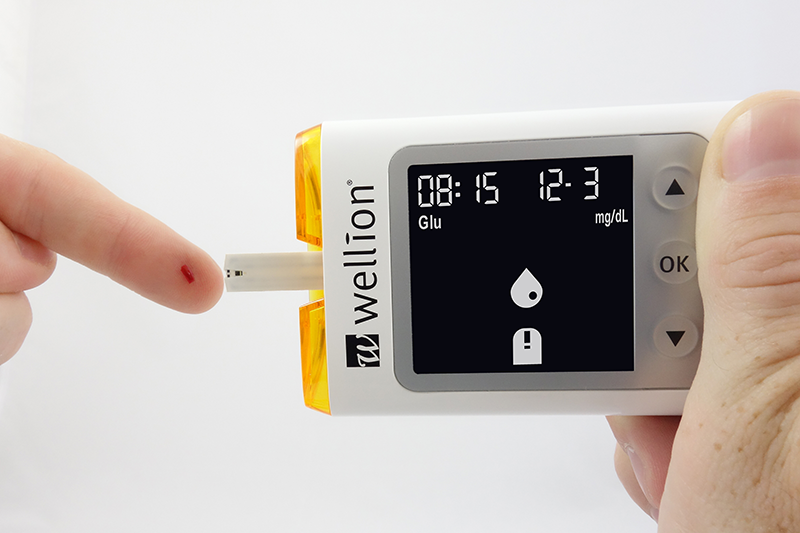
People with diabetes use the lateral sides of the fingertips to get a blood sample. Blood circulation is fine there and it is easy to get enough blood. Avoid the middle part of the fingertips as pricking there is very painful due to the high density of sensitive receptors.
One should consider the following topics to reduce problems with finger pricking:
- Hands should be thoroughly washed with warm water and soap and then dried. Beside the cleaning effect blood circulation is improved. Disinfection is not needed – alcohol residues could lead to wrong result.
- The lateral sides of the fingertips should be punctured to avoid pain – in the middle part of the fingertips are more sensitive receptors. Avoid to puncture the nail bed which could lead to inflammations.
- Replace the lancet every time after using it once – the needle will lose its sharp cut tip or could be bent. This will lead to more pain and will damage the skin. The danger of infections and inflammations through bacteria or viruses is increased.
- Use thin lancets (there are lancets available with a diameter of only 0.2mm) to reduce the pain when puncturing. As the size of the blood sample is depending on the depth of the puncture and not from the diameter of the lancet a blood drop of sufficient size is produced. Modern blood glucose meters only need minimal blood samples.
- Use different fingers for pricking – some people do not like to use the small finger or the thumb for getting a blood sample.
- If possible use fingers of both hands to get a blood sample.
- Try to find your optimal depth for puncture: maybe you do not have to prick very deep to get an appropriate blood sample. You can also press gently the arm or finger towards the end, shake the arm or let it hang down to improve process of blood sampling. Avoid pressing the finger to produce a blood drop.
- Press lancing device tightly to the lateral side of the fingertip and then release the button.
Blood Sampling
People with diabetes use the lateral sides of the fingertips to get a blood sample. Blood circulation is fine there and it is easy to get enough blood. Avoid the middle part of the fingertips as pricking there is very painful due to the high density of sensitive receptors.
Correct Handling of Test Strips
Storage of the Test Strips
- Store in dry places (not bathroom).
- After taking out a test strip from the vial immediately close it again to avoid entry of humidity.
- Do not store test strips in the car as temperatures in summer and winter can reach extremes.
- Check expiration date.
- If meter has to be coded do not forget to check code on the test strip vial and coding of the meter.
The adequate test strip
Every blood glucose meter has its own test strips where the blood sample has to be applied. The main reaction for measuring blood glucose takes place on the test strip.
Sources of error
Mistakes at measuring your blood glucose can lead to wrong results. There are multiple causes: operating problems with the meter, defective test strips or meters, different interferences.
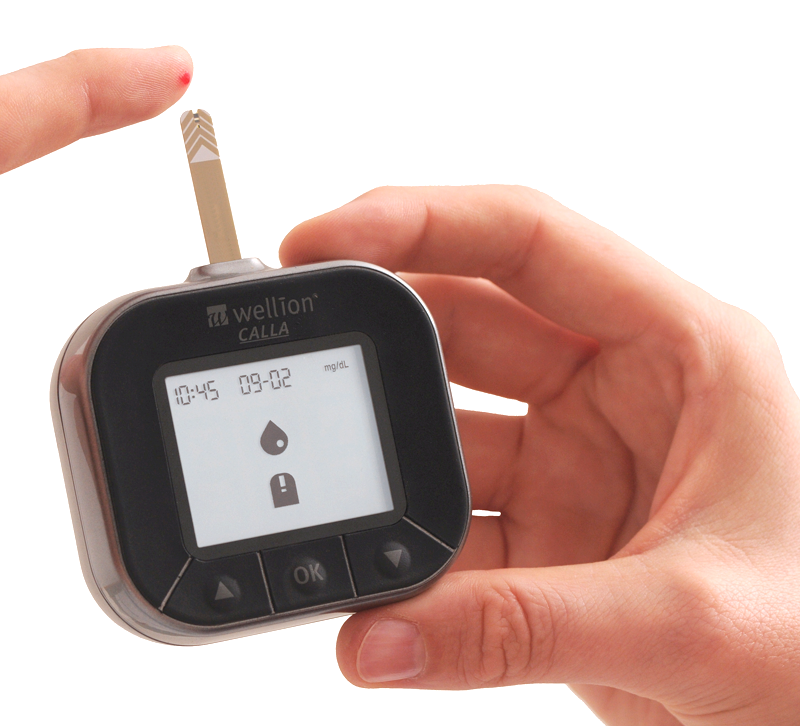
The user has to be trained to use the meter and the test strips to avoid problems. Using a meter is normally easy, and the training can be done quickly.
Tests with control solution from time to time ensure best quality of the blood glucose testing. It makes sense to perform a test with control solution when opening a new vial of test strips, if the meter dropped down or was somehow damaged, if the test results do not reflect your personal feeling or if results are somehow suspect.
Possible sources of error
Most problems are caused by mistakes during operation. Only on rare occasions meter, test strips or other interferences cause problems.
Damaged test strips
Test strips should not be exposed to direct sunlight, extreme humidity, cold or warm temperatures and should not be used after expiration date. These sensible diagnostics have to stored in the original vials, which should be closed immediately after taking out one strip.
Damaged meter
Blood glucose meters are high precision instruments and should be handled after the instructions of the manufacturer. The meter is operated with sufficiently charged batteries. Correct insertion of the test strip has to be checked.
Handling errors
Operation of a new meter has to be trained. The correct sampling of a blood drop should be educated as well:
- If the finger is pressed too much the blood sample will be diluted with liquids from the tissue which can lead to wrong results.
- Wash your hands thoroughly to avoid pollution of the blood sample with residues from food and for hygienic reasons.
- Dry hands thoroughly to avoid dilution of the blood sample with water.
- Disinfection is not needed.
- The size of the blood sample has to be sufficient to enable a correct testing at the reaction zone of the test strip.
- Do not move the test strip during the measurement.
- If using a meter which has to be coded do not forget to set the new code when opening a new vial of test strips.
- Heat, direct sunlight, extreme high humidity in the air (water steam) or freezing temperature harm meter and test strips.
Other interferences
Both substances from the body and from outside (medication e.g. vitamin C, Acetyl salicylic acid,..) can influence accuracy of the test results.
Values can deviate to higher or lower results. Please refer to Instruction for Use of your meter and your test strips. Test results can be inaccurate if a person has very high or very low hematocrite levels.
After intensive loss of water (strong diarrhoea or nausea) test results can be inaccurate. Residues of disinfecting agents have to completely disappear to avoid inaccurate results. Contact your diabetes health care team for further information.
Documentation
As every blood glucose value represents just a snap-shot it is useful to create a daily profile for several results per day. Self monitoring of blood glucose only makes sense if consequences are taken. It is important to write down test results in a diary.
This documentation is the background for the physician and the diabetes team to adjust the diabetes therapy, stores information regarding certain special situations and helps recognizing intra-daily fluctuations. Keep your diary regularely and correctly. If not noted results will be forgotten and are lost for ever.
How to keep record:
- Blood glucose value with date and time
- Intake of food (BE)
- Intake of insulin
- Special situations like sports, hypoglycaemia, stress, diseases, etc
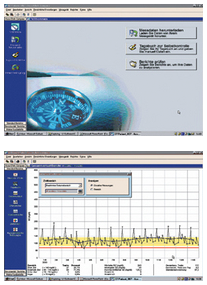
Modern technique assists you in your diabetes therapy. For most of the blood glucose monitoring systems data management systems are available. Special cables help to download data from your blood glucose meter to evaluate in it by means of your PC. With help of a personal computer the diabetes therapy gets even easier. An appropriate software helps to create an accurate documentation about therapy.